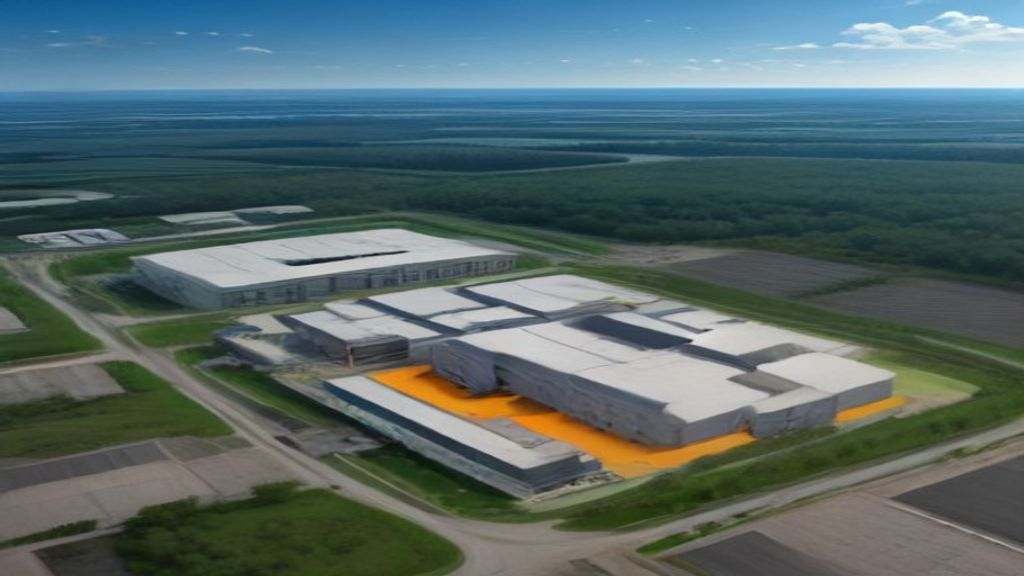
The largest coal plant in the United States emits roughly 20 million tons of CO2 per year. Amazon's new data center in West Texas has been permitted to release 33 million tons. Let that sink in.
The site, called GW Ranch, sits in Pecos County and will be powered by a dedicated natural gas plant running 35 turbines producing 7.65 gigawatts of electricity. That power won't flow into Texas's grid — at least not at first. It goes straight to Amazon's data center, essentially creating a private energy island in the desert.
Now, permits and actual emissions are different things. Companies almost never hit their permitted ceiling, and Amazon will likely fall well short of that 33-million-ton figure. But the fact that regulators signed off on those limits without blinking says a lot about where energy policy is heading under the current administration, which has been actively loosening restrictions on polluting power plants.
Here's the uncomfortable context: Amazon co-founded the Climate Pledge back in 2019, committing to carbon neutrality by 2040 — a full decade ahead of the Paris Agreement's target. Jeff Bezos made it a centerpiece of his public legacy. Since then, Amazon's actual emissions have gone up, not down, for multiple consecutive years. The culprit is no mystery: AI infrastructure is an energy monster, and Amazon is building a lot of it.
When pressed on the tension between GW Ranch and the Climate Pledge, an Amazon spokesperson told the New York Times that "the world looks different now than when we co-founded the climate pledge." That's a diplomatic way of saying the math no longer works the way they hoped.
Amazon isn't alone in this pivot. Meta and Google have both turned to gas and other non-renewables to keep their data centers running as AI demand explodes. The difference is scale. A dedicated off-grid power plant with this emissions ceiling is a new threshold, even by the standards of Big Tech's recent energy appetite.
Amazon did push back with some nuance. The company says it plans to explore on-site solar and battery storage, and that it's designed the plant to eventually connect to the broader Texas grid. They also made a point of saying cooling systems will use non-potable water so as not to strain local supplies — a real concern in West Texas, where water is scarce.
But "we're exploring solar" is a long way from actually building it. And the jobs promise — thousands of new positions in a rural county — is real, though it's also a classic play to lock in local political support before the environmental criticism arrives.
The bottom line is this: the AI boom is forcing a reckoning between tech companies' climate commitments and their infrastructure ambitions. Amazon just made that tension impossible to ignore.

AI
Powerful AI Agent Model Now Runs on a Raspberry Pi Without Cloud
A Raspberry Pi costs about 80 dollars. The idea that one could run a capable AI agent model on it — no cloud subscription, no GPU cluster, no data center required — would have sounded like a bad joke two years ago. Liquid AI just made it real.
The company, a Boston-based startup spun out of MIT, has released LFM2, a new family of small language models built around a fundamentally different architecture than the transformer-based systems that power most of today's AI. Their flagship small model, LFM2-5 at 2.6 billion parameters, is specifically designed to run inference on edge devices: phones, embedded systems, and yes, single-board computers like the Raspberry Pi.
The architectural difference matters more than it might seem. Most modern AI models are built on transformers, which are powerful but memory-hungry. They need to hold a lot of context in working memory, which is why running them typically requires serious hardware. Liquid AI's models use a hybrid architecture that blends ideas from recurrent networks and state-space models, which dramatically reduces memory overhead without gutting performance.
In practical terms, that means the model can handle agentic tasks — things like multi-step reasoning, tool use, and following complex instructions — on hardware that most people already own. That's a significant shift in who gets to build with capable AI, and where that AI can actually live.
Right now, the most capable AI agents require a round trip to the cloud every time they process a request. That creates latency, costs money, and raises real privacy concerns since your data is leaving your device. A genuinely capable on-device agent changes all three of those problems at once.
For enterprise use cases, the implications are even bigger. Think manufacturing floors, hospital equipment, remote infrastructure monitoring — environments where cloud connectivity is unreliable, expensive, or a security liability. Deploying AI agents in those settings has been a pain point for years. A model that runs locally on cheap hardware without meaningful performance degradation is exactly what those industries have been waiting for.
Liquid AI is positioning LFM2 against the growing field of small language models, which includes Microsoft's Phi series, Google's Gemma, and Meta's smaller Llama variants. The differentiator isn't just size — it's the efficiency-per-parameter story. Liquid claims their architecture punches above its weight on agentic benchmarks relative to transformer models of similar size.
The timing is pointed. As Amazon and others pour billions into massive data centers that require dedicated power plants, Liquid AI is betting that the next phase of AI deployment runs in the opposite direction — toward the edge, toward privacy, toward hardware that anyone can afford.
Both visions might end up being right. But one of them requires a 33-million-ton CO2 permit, and one fits in the palm of your hand.
Source: VentureBeat
The company, a Boston-based startup spun out of MIT, has released LFM2, a new family of small language models built around a fundamentally different architecture than the transformer-based systems that power most of today's AI. Their flagship small model, LFM2-5 at 2.6 billion parameters, is specifically designed to run inference on edge devices: phones, embedded systems, and yes, single-board computers like the Raspberry Pi.
The architectural difference matters more than it might seem. Most modern AI models are built on transformers, which are powerful but memory-hungry. They need to hold a lot of context in working memory, which is why running them typically requires serious hardware. Liquid AI's models use a hybrid architecture that blends ideas from recurrent networks and state-space models, which dramatically reduces memory overhead without gutting performance.
In practical terms, that means the model can handle agentic tasks — things like multi-step reasoning, tool use, and following complex instructions — on hardware that most people already own. That's a significant shift in who gets to build with capable AI, and where that AI can actually live.
Right now, the most capable AI agents require a round trip to the cloud every time they process a request. That creates latency, costs money, and raises real privacy concerns since your data is leaving your device. A genuinely capable on-device agent changes all three of those problems at once.
For enterprise use cases, the implications are even bigger. Think manufacturing floors, hospital equipment, remote infrastructure monitoring — environments where cloud connectivity is unreliable, expensive, or a security liability. Deploying AI agents in those settings has been a pain point for years. A model that runs locally on cheap hardware without meaningful performance degradation is exactly what those industries have been waiting for.
Liquid AI is positioning LFM2 against the growing field of small language models, which includes Microsoft's Phi series, Google's Gemma, and Meta's smaller Llama variants. The differentiator isn't just size — it's the efficiency-per-parameter story. Liquid claims their architecture punches above its weight on agentic benchmarks relative to transformer models of similar size.
The timing is pointed. As Amazon and others pour billions into massive data centers that require dedicated power plants, Liquid AI is betting that the next phase of AI deployment runs in the opposite direction — toward the edge, toward privacy, toward hardware that anyone can afford.
Both visions might end up being right. But one of them requires a 33-million-ton CO2 permit, and one fits in the palm of your hand.
Enjoyed this?
Get stories like this delivered every Tuesday — free.