
Here's a number that should stop you cold: gaining a single extra day of accurate hurricane forecasting used to take researchers roughly a decade of incremental work. Google DeepMind's weather model, WeatherNext, just handed forecasters that extra day in one shot.
The evidence comes from a real storm. When Hurricane Melissa was still organizing itself over the Caribbean in October 2025, meteorological models disagreed sharply about where it was headed and how bad it would get. WeatherNext broke from the pack, calling a Category 5 landfall on Jamaica with 80 percent confidence — five full days before the storm arrived. The prediction held. Melissa hit hard, bringing floods and landslides, but communities had more time to evacuate and prepare than they would have had otherwise.
A paper published Thursday in Nature puts numbers around what happened. On average, WeatherNext's track and intensity predictions three days out are as accurate as the best previous models' predictions at two days out. That one-day shift sounds modest on paper. In practice, it's the difference between an orderly evacuation and a chaotic one.
Mike Brennan, who runs the US National Hurricane Center, put it plainly: time is the scarcest resource when a major storm is bearing down. Staging emergency supplies, moving hospital patients, coordinating shelter logistics — all of it runs on tight timelines where a few hours can genuinely determine outcomes. An extra day of reliable forecasting doesn't just help planners feel better. It changes what's physically possible.
The engineering challenge behind WeatherNext is worth understanding. Machine learning models generally get smarter as you feed them more data, but hurricanes are rare by definition. There simply isn't a deep historical archive of cyclone observations to train on. DeepMind's team solved this by building a model that had to be good at everyday global weather first, then applied that broader atmospheric understanding to the specific problem of tropical cyclones.
That dual focus matters because hurricanes are unusually stubborn forecasting targets. Predicting which direction a storm travels requires a wide-angle view — where are the cold fronts, what are the prevailing winds doing thousands of miles away? Predicting how strong the storm gets is almost the opposite problem, demanding hyperlocal data about ocean temperatures and atmospheric conditions right at the storm's core. Previous AI weather models cracked the track problem reasonably well. Intensity, which is arguably more important for life-safety decisions, largely defeated them.
WeatherNext takes both seriously at once, and the Hurricane Melissa case suggests it's doing something genuinely new. It's still early — one hurricane season is not a statistically bulletproof sample — but the methodology is rigorous and the real-world test was about as high-stakes as it gets.
For a field where progress is usually measured in years and tenths of a percentage point, a full day of additional lead time is a significant jump. The next test will be whether WeatherNext holds up across a full Atlantic hurricane season, with all the messy, edge-case storms that tend to humble confident models. Forecasters will be watching closely.
SPACE
Mars Rover Drives Itself 90 Percent of the Time and Thrives
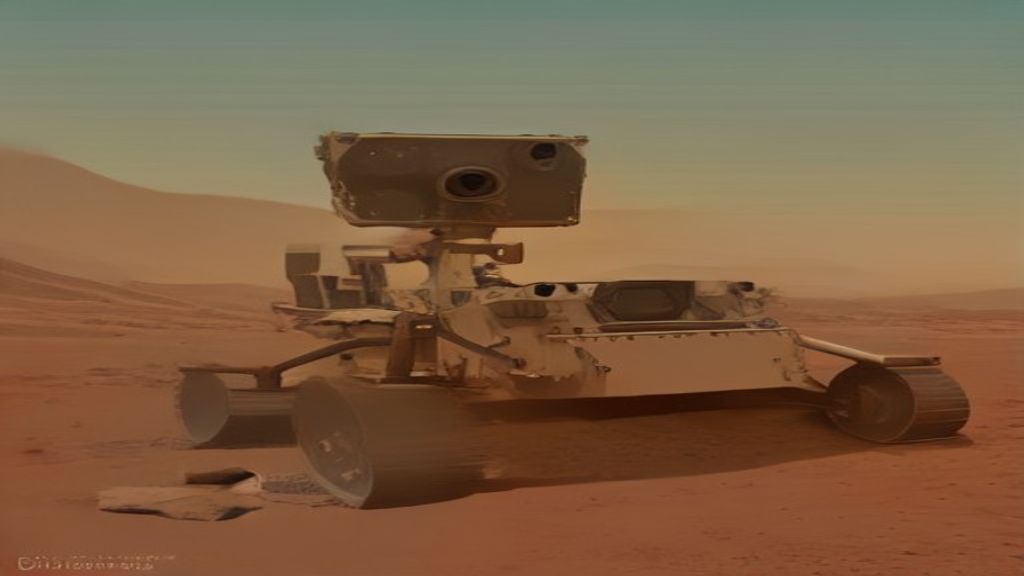
Perseverance is about to become the most well-traveled vehicle ever to drive on another planet — and it got there in roughly a third of the time its predecessor did. The secret is not better wheels or a faster top speed. It's that Perseverance is, for all practical purposes, a self-driving car on Mars.
Sometime next week, the rover will cross 45.16 kilometers of total distance traveled on the Martian surface, breaking the record previously held by the Opportunity rover, which spent fifteen years exploring before going silent in 2018. Perseverance has been on Mars since February 2021. Do the math and it's covered more ground in five years than Opportunity managed in fifteen.
The explanation comes down to computing power and autonomy. About 90 percent of the distance Perseverance has driven has been fully autonomous — the rover's onboard cameras scan the terrain, its computer calculates a safe path, and the wheels keep turning without waiting for anyone back on Earth to sign off. That last part is the key detail. A signal from Earth to Mars takes anywhere from three to twenty-two minutes depending on planetary alignment. If a rover has to stop, send images home, wait for a route decision, and receive instructions before moving again, it spends an enormous portion of each Martian day sitting still.
Perseverance's older sibling, Curiosity, actually has similar cameras and navigation algorithms. The difference is the processor. Curiosity's onboard computer includes chipsets that date to the 1990s, which means the number-crunching takes so long that only about 10 percent of its driving has been autonomous. In fifteen-plus years, it has covered 38.6 kilometers. Perseverance, with a modestly more capable Vision Compute Element, does its sensing and route calculation while the wheels are already in motion. Maximum speed is still just 150 meters per hour — Mars is not a highway — but eliminating all those stops compounds dramatically over time.
The scientific payoff has been equally real. Perseverance landed in Jezero Crater, a site chosen because it shows signs of an ancient river delta and potentially preserved biosignatures. The science targets are geographically spread out, which means the mission benefits enormously from a rover that can cover distance efficiently. Researchers have repeatedly found Perseverance arriving at new locations ahead of schedule, which sounds like a minor logistics win but actually opens up opportunities to investigate sites the team might not have prioritized otherwise.
This is a meaningful proof of concept for the broader future of planetary exploration. Missions deeper into the solar system, where communication delays will be even longer, will depend heavily on spacecraft and rovers that can make real-time decisions without phoning home. Perseverance is essentially running that experiment right now, and the results suggest that giving a robot enough processing power to think for itself is worth more than almost any other upgrade you could hand it.
The record will fall next week. What comes after it is the more interesting question.
Source: Ars Technica
Sometime next week, the rover will cross 45.16 kilometers of total distance traveled on the Martian surface, breaking the record previously held by the Opportunity rover, which spent fifteen years exploring before going silent in 2018. Perseverance has been on Mars since February 2021. Do the math and it's covered more ground in five years than Opportunity managed in fifteen.
The explanation comes down to computing power and autonomy. About 90 percent of the distance Perseverance has driven has been fully autonomous — the rover's onboard cameras scan the terrain, its computer calculates a safe path, and the wheels keep turning without waiting for anyone back on Earth to sign off. That last part is the key detail. A signal from Earth to Mars takes anywhere from three to twenty-two minutes depending on planetary alignment. If a rover has to stop, send images home, wait for a route decision, and receive instructions before moving again, it spends an enormous portion of each Martian day sitting still.
Perseverance's older sibling, Curiosity, actually has similar cameras and navigation algorithms. The difference is the processor. Curiosity's onboard computer includes chipsets that date to the 1990s, which means the number-crunching takes so long that only about 10 percent of its driving has been autonomous. In fifteen-plus years, it has covered 38.6 kilometers. Perseverance, with a modestly more capable Vision Compute Element, does its sensing and route calculation while the wheels are already in motion. Maximum speed is still just 150 meters per hour — Mars is not a highway — but eliminating all those stops compounds dramatically over time.
The scientific payoff has been equally real. Perseverance landed in Jezero Crater, a site chosen because it shows signs of an ancient river delta and potentially preserved biosignatures. The science targets are geographically spread out, which means the mission benefits enormously from a rover that can cover distance efficiently. Researchers have repeatedly found Perseverance arriving at new locations ahead of schedule, which sounds like a minor logistics win but actually opens up opportunities to investigate sites the team might not have prioritized otherwise.
This is a meaningful proof of concept for the broader future of planetary exploration. Missions deeper into the solar system, where communication delays will be even longer, will depend heavily on spacecraft and rovers that can make real-time decisions without phoning home. Perseverance is essentially running that experiment right now, and the results suggest that giving a robot enough processing power to think for itself is worth more than almost any other upgrade you could hand it.
The record will fall next week. What comes after it is the more interesting question.
Enjoyed this?
Get stories like this delivered every Tuesday — free.