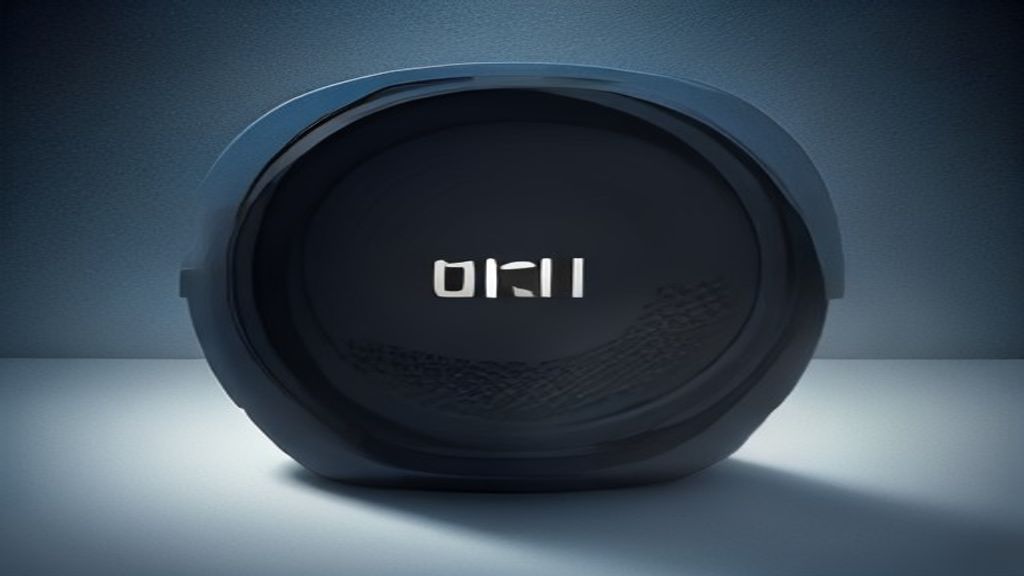
The most surprising thing about OpenAI and Jony Ive's mysterious AI device isn't the price tag north of $300. It's that the thing moves on its own.
According to Bloomberg's Mark Gurman, the device will feature moving parts that animate spontaneously to signal when it's listening, thinking, or responding. That's a deliberate design choice, not a gimmick — it's the product's primary way of communicating with you, since there's no screen involved.
What we're looking at, based on Gurman's reporting, is essentially a battery-powered smart speaker shaped like a doughnut and roughly the size of a hockey puck. It's built to travel room-to-room with you, one-handed, which explains both its compact footprint and the wireless power setup. Think of Amazon's old Tap speaker, except instead of playing your gym playlist, it's running one of the most powerful conversational AI models on the planet.
The device is expected to land sometime in 2027, which feels both far away and oddly close given how early-stage this all seems. It'll pack a camera system and additional sensors alongside the lights and moving components — more sensory awareness than your average kitchen speaker, and arguably more than most people expected from what sounded like a glorified ChatGPT accessory when the Ive-OpenAI partnership first leaked.
Here's where it gets interesting from a product strategy perspective. This isn't just a one-off gadget. Gurman suggests it's meant to be the first in a broader family of AI hardware devices OpenAI is planning. That positions the company less as a software business selling API access and more as a consumer hardware player — which is a very different game, with very different margins, supply chains, and failure modes.
The Ive angle matters here too. His design firm, LoveFrom, left Apple with an aesthetic reputation so strong that Bloomberg felt compelled to note this new device will look nothing like an Apple product. That's a curious detail, especially given that OpenAI and Apple are currently tangled in a legal dispute. Whatever Ive is building, it sounds like he's being deliberate about establishing visual distance from his former employer.
At $300-plus, this won't be an impulse buy. That price puts it in the same conversation as premium smart displays and entry-level earbuds ecosystems — products people research, not products they toss into a cart. OpenAI will need a compelling reason for consumers to choose a standalone AI device over just using the ChatGPT app they already have on their phone.
The moving parts might actually be that reason. There's something psychologically different about a physical object that reacts to you, versus a glowing rectangle in your pocket. Whether that difference is worth $300 is the question OpenAI has about two years left to answer.

SCIENCE
DeepMind AI Predicts Hurricanes Earlier Than Any Existing System
An AI model correctly predicted, with 80 percent confidence and five days out, that a developing Caribbean storm would slam into Jamaica as a Category 5 hurricane. That's not a stat from a simulation. That's what actually happened last October with Hurricane Melissa.
The model behind that call is WeatherNext, built by Google DeepMind and Google Research. A paper published this week in Nature details just how far ahead of existing forecasting systems it sits — on average, it delivers a full extra day of accurate lead time compared to traditional models. In practical terms, that means its three-day forecast is as reliable as what older systems could produce at two days. One day doesn't sound dramatic until you start counting what happens inside it.
Mike Brennan, director of the US National Hurricane Center, put it plainly: evacuation decisions, supply staging, emergency resource deployment — all of it is time-sensitive, and all of it can go catastrophically wrong if the forecast is off. Getting that window pushed back by 24 hours is the kind of improvement that historically took an entire decade of incremental work to achieve. DeepMind researchers say WeatherNext compressed that timeline significantly.
What makes the technical achievement particularly notable is what the model had to solve. Hurricanes are a forecasting nightmare because they operate at completely different scales simultaneously. Predicting where a storm goes requires global atmospheric data — cold fronts, jet streams, prevailing wind patterns. Predicting how strong it gets requires hyper-local data on ocean temperatures and atmospheric conditions right at the storm's core. Previous AI weather models cracked the track problem but essentially gave up on intensity.
Intensity is the variable that turns a manageable storm into a catastrophe. A system that can only tell you where a hurricane is heading but not how powerful it'll be when it arrives is only half useful — and in the worst cases, dangerously misleading.
DeepMind's approach to the training problem is worth understanding. Extreme weather events are, by definition, rare. That's a genuine obstacle for machine learning systems, which get better with volume. The team worked around this by training WeatherNext on the enormous body of general weather data first, then fine-tuning it on cyclone-specific patterns. The model learned weather broadly, then learned hurricanes as a specialized subset of that knowledge.
The real-world proof point is hard to argue with. Hurricane Melissa caused widespread flooding and landslides across Jamaica, but earlier warnings gave communities more time to prepare. That's the entire point of weather forecasting — not accuracy for its own sake, but accuracy that translates into human decisions made with better information.
As climate change continues to influence storm behavior and intensity, getting this right earlier matters more than ever. WeatherNext looks like a meaningful step in that direction.
Source: WIRED
The model behind that call is WeatherNext, built by Google DeepMind and Google Research. A paper published this week in Nature details just how far ahead of existing forecasting systems it sits — on average, it delivers a full extra day of accurate lead time compared to traditional models. In practical terms, that means its three-day forecast is as reliable as what older systems could produce at two days. One day doesn't sound dramatic until you start counting what happens inside it.
Mike Brennan, director of the US National Hurricane Center, put it plainly: evacuation decisions, supply staging, emergency resource deployment — all of it is time-sensitive, and all of it can go catastrophically wrong if the forecast is off. Getting that window pushed back by 24 hours is the kind of improvement that historically took an entire decade of incremental work to achieve. DeepMind researchers say WeatherNext compressed that timeline significantly.
What makes the technical achievement particularly notable is what the model had to solve. Hurricanes are a forecasting nightmare because they operate at completely different scales simultaneously. Predicting where a storm goes requires global atmospheric data — cold fronts, jet streams, prevailing wind patterns. Predicting how strong it gets requires hyper-local data on ocean temperatures and atmospheric conditions right at the storm's core. Previous AI weather models cracked the track problem but essentially gave up on intensity.
Intensity is the variable that turns a manageable storm into a catastrophe. A system that can only tell you where a hurricane is heading but not how powerful it'll be when it arrives is only half useful — and in the worst cases, dangerously misleading.
DeepMind's approach to the training problem is worth understanding. Extreme weather events are, by definition, rare. That's a genuine obstacle for machine learning systems, which get better with volume. The team worked around this by training WeatherNext on the enormous body of general weather data first, then fine-tuning it on cyclone-specific patterns. The model learned weather broadly, then learned hurricanes as a specialized subset of that knowledge.
The real-world proof point is hard to argue with. Hurricane Melissa caused widespread flooding and landslides across Jamaica, but earlier warnings gave communities more time to prepare. That's the entire point of weather forecasting — not accuracy for its own sake, but accuracy that translates into human decisions made with better information.
As climate change continues to influence storm behavior and intensity, getting this right earlier matters more than ever. WeatherNext looks like a meaningful step in that direction.
Enjoyed this?
Get stories like this delivered every Tuesday — free.