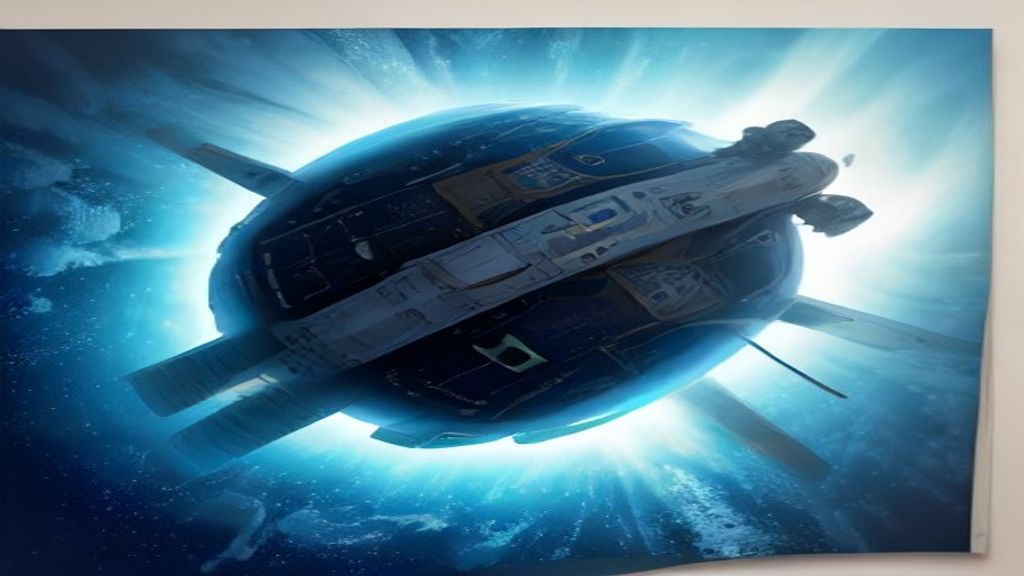
A refrigerator-size spacecraft is currently spinning out of control in low Earth orbit — and somehow, that's actually the more manageable version of this story.
The satellite in question is called Link, and it was sent up specifically to rescue NASA's Swift gamma-ray observatory, a $500 million telescope that has been slowly losing altitude for years. Last Saturday, without warning, Link began tumbling on multiple axes. Two of its three reaction wheels failed. Its cold gas thrusters developed a fault. For a mission already operating on a razor-thin timeline, this was about the worst thing that could happen short of a full blackout.
Katalyst Space Technologies, the Denver-area startup behind Link, had already been working under unusual pressure. NASA handed them a contract worth $30 million and less than a year to design, build, launch, and fly a servicer satellite to a specific observatory in orbit — a task that typically takes years. Link launched on July 3rd, and for nearly a month, everything was going fine. Then it wasn't.
Here's what makes this situation genuinely fascinating: the fix Katalyst is using isn't the one Link was designed for. The spacecraft carries three xenon-fueled electric thrusters, which are normally meant for raising the satellite's orbit. But because those thrusters can pivot on a two-axis gimbal, engineers have been pointing them against the direction of the spin to bleed off rotational energy. It's a bit like trying to stop a spinning top by blowing on it — slow, but surprisingly effective.
As of Friday, the team had already cut Link's rotation rate in half, dropping from roughly 9 degrees per second down to about 4. That's still too fast for stable operations, but it's enough progress to suggest the approach is working. The goal now is to get the spin slow enough that Link can hold a steady antenna lock with ground stations, which would let engineers run proper diagnostics and plan next steps.
The stakes here go well beyond one satellite. This is the first time NASA has ever hired a commercial company to physically service one of its own spacecraft in orbit. If Katalyst pulls this off — rescuing Swift and then completing the orbit boost — it validates an entirely new model for extending the life of aging government hardware without building and launching replacements from scratch. That's potentially worth billions in future contracts.
If they don't pull it off, the window is closing fast. Swift will drift too low to reach within a matter of months. Katalyst's CEO, Ghonhee Lee, has been candid about the challenge while remaining cautiously optimistic. The ground team is working around the clock, and the spacecraft's core systems — power, rendezvous hardware, robotics — are all still healthy.
The mission isn't over. But the margin for error just got a lot thinner.
AI
Tesla China Swaps Siri for ByteDance AI Across Four Vehicle Lines
Tesla just quietly handed over its in-car voice assistant duties in China to ByteDance — and the move tells you a lot about how the global AI race is actually playing out inside real products.
With the rollout of software version 2026.14.13, Tesla has formally embedded ByteDance's Doubao large language model into the Model 3, Model Y, Model S, and Model X for Chinese customers. The update is being pushed to newly delivered vehicles and some existing cars in batches, replacing the previous voice setup with a dedicated Doubao app that lives natively inside the infotainment system.
Doubao isn't just handling casual conversation. Tesla has wired it into core vehicle controls — navigation commands, media playback, climate adjustments, and owner manual lookups all route through the model. It comes with four voice options and five interaction modes, covering everything from real-time information queries to English language practice and debate. That last one is a distinctly Chinese market feature, reflecting how ByteDance has shaped Doubao around local user habits.
Interestingly, Doubao isn't the only AI model in the car. DeepSeek is also present, handling broader AI interactions while Doubao owns the voice-command layer. That's a notable architectural choice — Tesla essentially built a two-model setup, segmenting tasks between the two biggest names in Chinese AI right now. It's less a single assistant and more a tag team.
The business logic here is pretty clear. Tesla has been under significant competitive pressure in China from domestic EV brands like BYD, Nio, and Li Auto, all of which have aggressively integrated local AI assistants and smart features tailored to Chinese consumers. Partnering with ByteDance — whose Doubao app has become one of the fastest-growing AI products in the country — signals that Tesla understands it can't just port its Western software stack into the Chinese market and call it a day.
It also reflects a broader pattern of foreign tech companies making deliberate local-AI pivots to stay relevant in China. Apple integrated Baidu and other local AI partners into its China-specific features. Now Tesla is doing the same with its vehicles. The product might look the same from the outside, but under the hood, the intelligence powering it is increasingly homegrown.
What's worth watching is whether this kind of AI fragmentation — different models for different markets — becomes standard for global tech companies. Running separate AI stacks by region creates real complexity in development and quality control. But given how quickly local models like Doubao and DeepSeek have matured, the alternative — shipping a single global model that underperforms in key markets — might be the riskier bet.
For now, Tesla's China customers get a noticeably smarter voice assistant. And ByteDance gets a very large, very visible showcase for its AI ambitions.
Source: TechNode
With the rollout of software version 2026.14.13, Tesla has formally embedded ByteDance's Doubao large language model into the Model 3, Model Y, Model S, and Model X for Chinese customers. The update is being pushed to newly delivered vehicles and some existing cars in batches, replacing the previous voice setup with a dedicated Doubao app that lives natively inside the infotainment system.
Doubao isn't just handling casual conversation. Tesla has wired it into core vehicle controls — navigation commands, media playback, climate adjustments, and owner manual lookups all route through the model. It comes with four voice options and five interaction modes, covering everything from real-time information queries to English language practice and debate. That last one is a distinctly Chinese market feature, reflecting how ByteDance has shaped Doubao around local user habits.
Interestingly, Doubao isn't the only AI model in the car. DeepSeek is also present, handling broader AI interactions while Doubao owns the voice-command layer. That's a notable architectural choice — Tesla essentially built a two-model setup, segmenting tasks between the two biggest names in Chinese AI right now. It's less a single assistant and more a tag team.
The business logic here is pretty clear. Tesla has been under significant competitive pressure in China from domestic EV brands like BYD, Nio, and Li Auto, all of which have aggressively integrated local AI assistants and smart features tailored to Chinese consumers. Partnering with ByteDance — whose Doubao app has become one of the fastest-growing AI products in the country — signals that Tesla understands it can't just port its Western software stack into the Chinese market and call it a day.
It also reflects a broader pattern of foreign tech companies making deliberate local-AI pivots to stay relevant in China. Apple integrated Baidu and other local AI partners into its China-specific features. Now Tesla is doing the same with its vehicles. The product might look the same from the outside, but under the hood, the intelligence powering it is increasingly homegrown.
What's worth watching is whether this kind of AI fragmentation — different models for different markets — becomes standard for global tech companies. Running separate AI stacks by region creates real complexity in development and quality control. But given how quickly local models like Doubao and DeepSeek have matured, the alternative — shipping a single global model that underperforms in key markets — might be the riskier bet.
For now, Tesla's China customers get a noticeably smarter voice assistant. And ByteDance gets a very large, very visible showcase for its AI ambitions.
Enjoyed this?
Get stories like this delivered every Tuesday — free.