The team that deployed snake robots into Venezuelan earthquake rubble learned they were going while standing between Third Eye Blind and Nelly on a concert stage. That detail alone tells you everything about how quickly disaster response decisions get made — and how ready these researchers needed to be.
When two earthquakes struck Venezuela on June 24, killing more than 5,000 people and injuring over 16,000 more, rescue teams flooded in from around the world carrying the usual toolkit: trained dogs, acoustic sensors, cameras on poles, thermal imaging equipment. Carnegie Mellon's Biorobotics Lab brought something different — four-foot-long robotic snakes that could do what none of those other tools could.
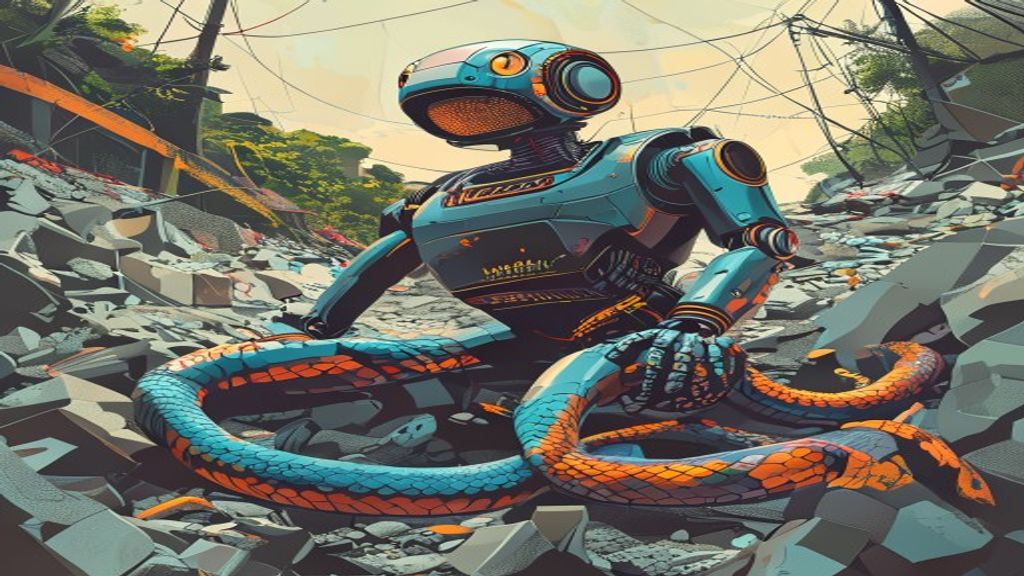
The fundamental problem with collapsed buildings isn't just finding survivors. It's that the debris fields are essentially impassable mazes of concrete and steel, too unstable for humans to enter and too narrow for conventional robots to navigate. Snake robots solve that by doing what their biological namesakes do naturally — threading through gaps that nothing else can fit through.
Howie Choset, who runs CMU's Biorobotics Lab and has spent nearly twenty years developing these machines, described the approach as performing minimally invasive surgery on a building. Rather than tearing through rubble to reach survivors, you send something slim and flexible in first, extending rescuers' visual reach without putting anyone else at risk. It's a meaningfully different philosophy from brute-force disaster response.
The robots themselves are impressively practical in design. Each unit is modular, built from individual segments that can be swapped, upgraded, or replaced in the field. A human operator drives using a standard video game controller connected to a laptop that also powers the robot. The software handles the complicated part — automatically coordinating how each body segment moves so the operator only has to think about where to go, not how to get there.
What's particularly striking about this deployment is how it came together. A Venezuelan-born woman living in Atlanta, Beatriz Gonzalez, was searching for ways to help rescue operations and asked the AI chatbot Grok for suggestions. Grok surfaced a Carnegie Mellon article about the robots' first real-world test — a collapsed apartment building in Mexico City following a 2017 earthquake. Gonzalez called the lab directly. The researchers said yes.
Days later, they were packing frantically through the night, replacing camera modules and loading extra batteries before flying out. The gap between a phone call and active deployment in a foreign disaster zone was measured in days, not months.
That speed matters as much as the technology itself. Earthquake survivors face a brutal survival curve — the odds of finding someone alive drop sharply after the first 72 hours. Having robots that can be packed into cases, flown internationally, and deployed quickly by a small team isn't just an engineering achievement. It's a logistical one.
CMU's snake robots have also been tested underwater and used in surgical settings, but search and rescue remains their most urgent application. Venezuela was only their second major earthquake deployment. It almost certainly won't be their last.
ROBOTICS
Robot Snakes Deployed to Find Survivors in Venezuela Earthquake Rubble
Source: Ars Technica
AI
Microsoft's New In-House AI Models Undercut OpenAI Pricing by 89 Percent
Microsoft reportedly cut AI model pricing by up to 89 percent compared to OpenAI — which is a remarkable number given that Microsoft is also OpenAI's biggest investor and most important commercial partner. If that tension feels awkward, it should.
For years, Microsoft's AI strategy looked straightforward: invest heavily in OpenAI, integrate those models into Azure and the broader Microsoft product suite, and let the partnership do the heavy lifting. That arrangement made sense when OpenAI held a clear capability lead and Microsoft was still building out its AI infrastructure. The calculus appears to be shifting.
Developing in-house models gives Microsoft something the OpenAI partnership never could — full control over pricing, deployment, and the economics of inference at scale. When you're running AI workloads across Azure's global infrastructure for thousands of enterprise customers, even modest per-token cost reductions compound into enormous dollar figures. An 89 percent reduction isn't modest. It's a structural change in how Microsoft thinks about AI profitability.
This also isn't happening in isolation. The broader AI model market has been experiencing aggressive price compression over the past year, driven by competition from Anthropic, Google, Meta's open-source Llama releases, and a wave of smaller but surprisingly capable models from startups. OpenAI itself has been cutting prices repeatedly to stay competitive. Microsoft entering the model business directly accelerates that pressure significantly.
The more interesting question is what this means for OpenAI. Microsoft remains the company's primary commercial distributor, providing the cloud infrastructure that powers ChatGPT and API access for developers. But if Microsoft's own models are substantially cheaper and available through the same Azure platform, enterprise customers face a straightforward cost comparison every time they evaluate their AI spending. Loyalty is expensive at 89 percent.
There's a reasonable argument that OpenAI isn't immediately threatened here — frontier model capability still matters enormously for complex tasks, and Microsoft's in-house models likely aren't competing at the very top of the performance range. Enterprises running sophisticated reasoning tasks or building products that require state-of-the-art output won't simply switch because something cheaper exists. But a huge portion of enterprise AI usage isn't at the frontier. It's summarization, classification, document processing, customer service automation — workloads where good-enough models at dramatically lower prices are an easy sell.
Microsoft has watched this dynamic play out in cloud computing for decades. Commodity infrastructure gets cheaper over time, margins compress, and the companies that control the full stack — from hardware to platform to application — end up with structural advantages over those that don't. They appear to be applying the same logic to AI.
What makes this moment particularly worth watching is the signal it sends about where Microsoft thinks AI economics are headed. Building and deploying your own models is expensive and difficult. You don't do it just to have options — you do it because you've decided the partnership model has real limits. Microsoft seems to have made that decision.
Source: VentureBeat
For years, Microsoft's AI strategy looked straightforward: invest heavily in OpenAI, integrate those models into Azure and the broader Microsoft product suite, and let the partnership do the heavy lifting. That arrangement made sense when OpenAI held a clear capability lead and Microsoft was still building out its AI infrastructure. The calculus appears to be shifting.
Developing in-house models gives Microsoft something the OpenAI partnership never could — full control over pricing, deployment, and the economics of inference at scale. When you're running AI workloads across Azure's global infrastructure for thousands of enterprise customers, even modest per-token cost reductions compound into enormous dollar figures. An 89 percent reduction isn't modest. It's a structural change in how Microsoft thinks about AI profitability.
This also isn't happening in isolation. The broader AI model market has been experiencing aggressive price compression over the past year, driven by competition from Anthropic, Google, Meta's open-source Llama releases, and a wave of smaller but surprisingly capable models from startups. OpenAI itself has been cutting prices repeatedly to stay competitive. Microsoft entering the model business directly accelerates that pressure significantly.
The more interesting question is what this means for OpenAI. Microsoft remains the company's primary commercial distributor, providing the cloud infrastructure that powers ChatGPT and API access for developers. But if Microsoft's own models are substantially cheaper and available through the same Azure platform, enterprise customers face a straightforward cost comparison every time they evaluate their AI spending. Loyalty is expensive at 89 percent.
There's a reasonable argument that OpenAI isn't immediately threatened here — frontier model capability still matters enormously for complex tasks, and Microsoft's in-house models likely aren't competing at the very top of the performance range. Enterprises running sophisticated reasoning tasks or building products that require state-of-the-art output won't simply switch because something cheaper exists. But a huge portion of enterprise AI usage isn't at the frontier. It's summarization, classification, document processing, customer service automation — workloads where good-enough models at dramatically lower prices are an easy sell.
Microsoft has watched this dynamic play out in cloud computing for decades. Commodity infrastructure gets cheaper over time, margins compress, and the companies that control the full stack — from hardware to platform to application — end up with structural advantages over those that don't. They appear to be applying the same logic to AI.
What makes this moment particularly worth watching is the signal it sends about where Microsoft thinks AI economics are headed. Building and deploying your own models is expensive and difficult. You don't do it just to have options — you do it because you've decided the partnership model has real limits. Microsoft seems to have made that decision.
Enjoyed this?
Get stories like this delivered every Tuesday — free.