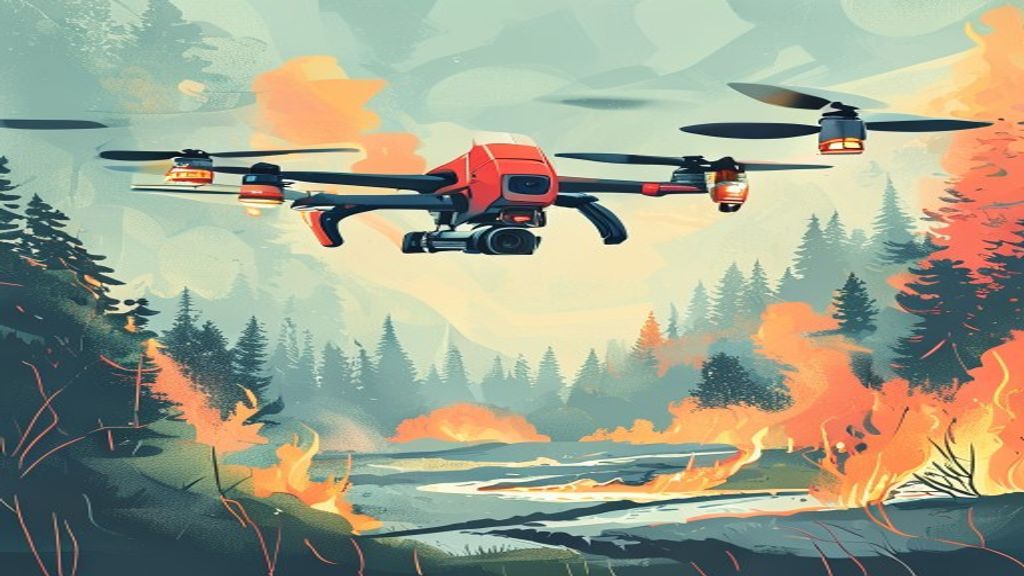
A swarm of autonomous drones can be ready to fly again within two minutes of landing — that's the pitch from California-based startup Seneca, and it might be the most important number in wildfire response right now.
Wildfire season in the United States has quietly stopped being a season. Climate shifts have stretched fire risk across most of the calendar year, and the tools used to fight those fires — massive crewed airtankers, ground crews, and overtaxed emergency services — haven't kept pace. Drones aren't going to replace a 747 supertanker dropping thousands of gallons on a raging ridge fire. But that's not really the point.
The real opportunity is interception. Catch a fire when it's still a smoldering patch of dry brush, and you don't need a supertanker. That's the theory being tested right now in California and Alaska, and early results are genuinely interesting.
On July 15, the California Department of Forestry and Fire Protection ran a field demonstration with five autonomous drones that collectively deployed between 500 and 1,000 gallons of firefighting foam. The drones were built by Seneca, whose Argo-1 model carries roughly 100 pounds of water or retardant per flight. A human operator uploads a GPS waypoint, and from there the drones handle the rest — flying to the target, reading heat signatures with onboard sensors, finding the right altitude, and lining up to spray the fire in sequence.
The hardware is deliberately unglamorous. Each drone fits in the bed of a pickup truck with the tailgate down. Two people can carry an empty unit by hand. Seneca's goal is a two-minute turnaround between landing and relaunch — swap the battery, refill the tank, send it back up. For a small, fast-moving fire, that kind of persistence could matter more than raw payload size.
There are real limitations worth naming. The Argo-1 tops out at a 10-mile round trip at around 30 miles per hour, which means these drones need to be staged close to fire-prone areas to be useful. You can't scramble them from a depot two counties away and expect to intercept anything. Prepositioned deployment adds logistical complexity and cost.
Still, the Alaska trial adds a compelling layer to the story. The XPRIZE Wildfire competition held its finals near Fairbanks in June, where a system called Silvaguard — built by German firm Dryad Networks — autonomously detected and suppressed a wildfire within a 1,000-square-kilometer test zone. Dryad's approach combines solar-powered tree-mounted sensors that detect smoldering smoke early, a wireless mesh network to relay the alarm, and drones that respond without waiting for a human to make the call.
That end-to-end autonomy is where things get philosophically interesting. Letting a machine decide when and where to deploy firefighting resources is a significant step, and it will raise questions about accountability when something goes wrong. But given that wildfires now routinely outpace human response times, the alternative — waiting — is starting to look like the riskier option.
The $11 million XPRIZE competition is doing real work here by creating a structured environment to stress-test these systems before lives depend on them. Whether any of this scales into operational deployment before the next major fire season is the question nobody can fully answer yet.
POLICY
Judge Blocks Paramount and Warner Bros. $111 Billion Merger
A federal judge didn't just pump the brakes on the Paramount-Warner Bros. merger — she essentially said the deal looks like it was probably illegal before the trial even started.
US District Judge Araceli Martínez-Olguín issued a temporary restraining order this week blocking the $111 billion combination of Paramount Skydance and Warner Bros. Discovery from moving forward. The order is technically only valid for 14 days, but it can be converted into a preliminary injunction that would freeze the deal until the full case is resolved. In other words, this isn't a speed bump — it's potentially a wall.
The lawsuit was filed by a coalition of 12 states led by California, one week after the Trump administration signed off on the deal. That approval-to-lawsuit timeline tells you something about how charged the political environment around media consolidation has become. California Attorney General Rob Bonta called the court order a "critical first win" and made clear his office intends to see the case through to the end.
The core antitrust argument isn't complicated. Paramount and Warner Bros. are two of Hollywood's five major studios. They also each own significant chunks of basic cable television. Combining them removes one of a small number of competitors from two already concentrated markets simultaneously.
The judge found the states made a strong showing that the merger would substantially reduce competition in the theatrical film market. The merged company would control roughly 27 percent of wide-release theatrical distribution — just below the 30 percent threshold courts have traditionally used to presume antitrust harm, but the judge was explicit that 30 percent isn't some magic floor. Concentration below that level can still be a problem, and she found the spike in the Herfindahl-Hirschman Index — the standard economic measure of market concentration — was enough to support the restraining order on its own.
There's a broader context here worth sitting with. Hollywood has been consolidating for years, and streaming wars have accelerated the pressure on studios to get bigger or get acquired. Paramount spent years shopping itself around before landing this deal. Warner Bros. Discovery itself was the product of a massive merger not long ago. The studios argue that scale is a survival mechanism in a world where Netflix and Amazon have essentially unlimited content budgets.
But the states are making a different argument: that consolidation among the legacy players doesn't create a stronger competitor to streaming giants, it just reduces options for theater owners, cable operators, and ultimately audiences.
The judge also noted that Paramount and Warner Bros. wouldn't suffer meaningful harm from a delay of a few months, which is the kind of sentence that tends to signal a judge isn't in a hurry to let a deal close. The companies will almost certainly fight for a preliminary injunction hearing quickly. But right now, one of the biggest media mergers in recent memory is on ice — and the states put it there.
Source: Ars Technica
US District Judge Araceli Martínez-Olguín issued a temporary restraining order this week blocking the $111 billion combination of Paramount Skydance and Warner Bros. Discovery from moving forward. The order is technically only valid for 14 days, but it can be converted into a preliminary injunction that would freeze the deal until the full case is resolved. In other words, this isn't a speed bump — it's potentially a wall.
The lawsuit was filed by a coalition of 12 states led by California, one week after the Trump administration signed off on the deal. That approval-to-lawsuit timeline tells you something about how charged the political environment around media consolidation has become. California Attorney General Rob Bonta called the court order a "critical first win" and made clear his office intends to see the case through to the end.
The core antitrust argument isn't complicated. Paramount and Warner Bros. are two of Hollywood's five major studios. They also each own significant chunks of basic cable television. Combining them removes one of a small number of competitors from two already concentrated markets simultaneously.
The judge found the states made a strong showing that the merger would substantially reduce competition in the theatrical film market. The merged company would control roughly 27 percent of wide-release theatrical distribution — just below the 30 percent threshold courts have traditionally used to presume antitrust harm, but the judge was explicit that 30 percent isn't some magic floor. Concentration below that level can still be a problem, and she found the spike in the Herfindahl-Hirschman Index — the standard economic measure of market concentration — was enough to support the restraining order on its own.
There's a broader context here worth sitting with. Hollywood has been consolidating for years, and streaming wars have accelerated the pressure on studios to get bigger or get acquired. Paramount spent years shopping itself around before landing this deal. Warner Bros. Discovery itself was the product of a massive merger not long ago. The studios argue that scale is a survival mechanism in a world where Netflix and Amazon have essentially unlimited content budgets.
But the states are making a different argument: that consolidation among the legacy players doesn't create a stronger competitor to streaming giants, it just reduces options for theater owners, cable operators, and ultimately audiences.
The judge also noted that Paramount and Warner Bros. wouldn't suffer meaningful harm from a delay of a few months, which is the kind of sentence that tends to signal a judge isn't in a hurry to let a deal close. The companies will almost certainly fight for a preliminary injunction hearing quickly. But right now, one of the biggest media mergers in recent memory is on ice — and the states put it there.
Enjoyed this?
Get stories like this delivered every Tuesday — free.