
Here's an irony worth sitting with: Meta built a secret program to spy on its own employees, then accidentally let those same employees spy on each other.
The company has been quietly running something called the Model Capability Initiative since April — a program that logs keystrokes, mouse clicks, and on-screen content from US employee laptops, ostensibly to train AI models. The whole thing was already controversial. Then, this week, an internal security notice revealed that data from roughly 45,000 internal database tables had been left wide open to anyone inside the company. We're talking full prompt transcriptions, private conversations, and performance data — essentially a surveillance buffet, self-served.
Meta's CTO Andrew Bosworth acknowledged the screw-up internally, pointing to misconfigured access control lists as the culprit. In corporate terms, that means the digital locks on sensitive data weren't set up correctly, so the wrong people could walk right in. Bosworth, to his credit, didn't sugarcoat it — he said the program's implementation fell short of the standards its own privacy review had outlined.
The timing couldn't be worse for Meta's leadership. Just last month, more than 1,600 employees signed an internal petition protesting the laptop surveillance program. Their core argument was that collecting this kind of intimate behavioral data created serious privacy risks. Meta's response at the time was essentially: trust us, it's tightly controlled. Then the data leaked internally within weeks.
The employee reaction inside Meta's forums ranged from pointed questions to outright mockery. One worker posted a meme from The Office — Jim Halpert holding a sign reading "0 days since our last nonsense." When your own staff is dunking on you in the internal Slack equivalent, you've lost the room.
Meta says it has paused the data collection program indefinitely while it investigates, and the security incident has reportedly been marked as resolved. But pausing a program isn't the same as ending it, and the company hasn't exactly explained what it plans to do with the data it already collected.
The deeper issue here isn't just a misconfigured database. It's about what employers can reasonably ask of workers in the name of AI development. Meta was essentially turning its own workforce into a training dataset — logging their most granular daily behaviors without, apparently, getting the internal infrastructure right to protect that information.
There's a version of this story where employee monitoring for AI training is a reasonable, well-governed practice. This was not that version. Meta built a surveillance program, told nervous employees it was airtight, and then demonstrated in the most embarrassing way possible that it wasn't. Whatever trust existed around this initiative is now gone, and rebuilding it will take more than a pause button.
ROBOTICS
GM replaces 1,300 laid-off workers with robots at flagship EV plant
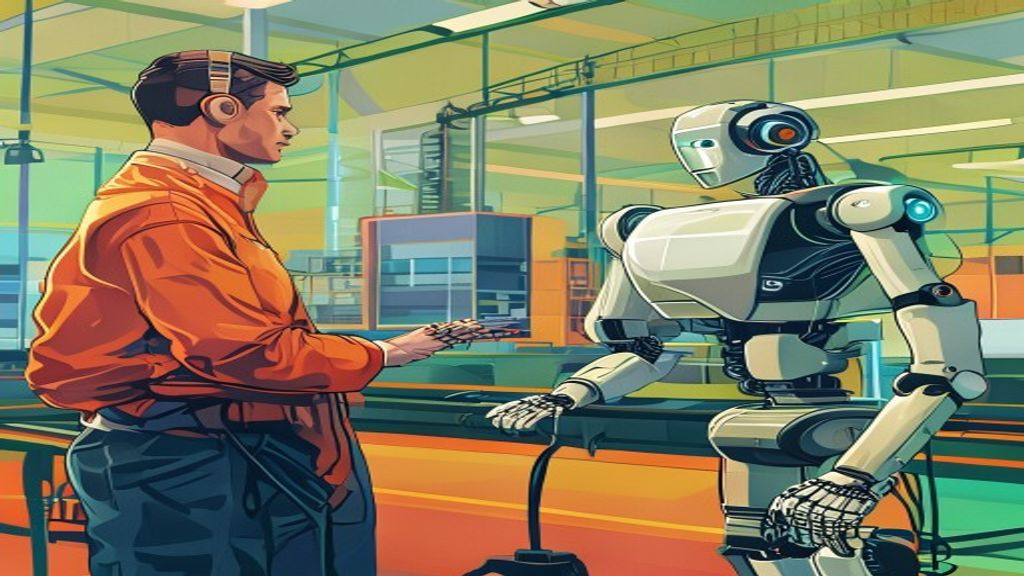
General Motors laid off 1,300 workers at its Detroit EV plant in March, called it temporary, and then installed robots to do the work. That's not a metaphor. That's what happened.
About 50 robotic arms made by Japanese manufacturer FANUC are now operating on the assembly line at GM's Factory Zero facility in Detroit, handling component attachment tasks during vehicle production. The union representing those workers isn't buying the "temporary" framing anymore. James Cotton, president of UAW Local 22, made the math pretty simple: you have 50 robots doing jobs and more than 1,000 members still sitting at home without a callback date.
This layoff wave didn't start in March. In October 2025, GM had already made permanent cuts involving another 1,200 workers at the same plant. So Factory Zero has now shed a significant portion of its human workforce across two separate rounds, and the answer to filling the gap appears to be automation rather than rehiring.
The frustration from workers is understandable, but what makes this moment particularly charged is the context around it. The same week GM's robot arms were making headlines, Detroit hosted two very different kinds of gatherings. At the Reindustrialize Summit, startup founders were pitching automation as a way to build a stronger industrial base. Across town, at the UAW Constitutional Convention, union president Shawn Fain was warning that humanoid robotics and mass automation pose an existential threat to working-class employment and wages.
Those two conversations happened in the same city, in the same week, without much overlap. That gap between how executives and workers talk about automation is not new, but it's rarely been this visually stark.
GM isn't alone in this direction. Ford and Stellantis have both been expanding robotic assembly lines. Hyundai plans to deploy Boston Dynamics' Atlas humanoid robots at its Georgia EV plant by 2028. The industry is clearly moving toward fewer humans on the factory floor, and the question is no longer whether that happens but how fast and who absorbs the cost.
Andrew Bergman, a laid-off Local 22 member, put it plainly: automation has the potential to make work safer and give people more time. The problem is who controls it and what they decide to do with the gains. Right now, those gains are going to the balance sheet.
The dark factory model — near-complete automation with a skeleton crew for oversight — is already operational in parts of East Asia. FANUC, the company supplying GM's robot arms, runs one of those facilities itself. The US auto industry is not there yet, but the direction of travel is hard to misread.
For the 1,300 workers still waiting on a callback from GM, the arrival of 50 robot arms isn't an abstraction about the future of work. It's a pretty clear answer to a question they were still hoping had a different one.
Source: Ars Technica
About 50 robotic arms made by Japanese manufacturer FANUC are now operating on the assembly line at GM's Factory Zero facility in Detroit, handling component attachment tasks during vehicle production. The union representing those workers isn't buying the "temporary" framing anymore. James Cotton, president of UAW Local 22, made the math pretty simple: you have 50 robots doing jobs and more than 1,000 members still sitting at home without a callback date.
This layoff wave didn't start in March. In October 2025, GM had already made permanent cuts involving another 1,200 workers at the same plant. So Factory Zero has now shed a significant portion of its human workforce across two separate rounds, and the answer to filling the gap appears to be automation rather than rehiring.
The frustration from workers is understandable, but what makes this moment particularly charged is the context around it. The same week GM's robot arms were making headlines, Detroit hosted two very different kinds of gatherings. At the Reindustrialize Summit, startup founders were pitching automation as a way to build a stronger industrial base. Across town, at the UAW Constitutional Convention, union president Shawn Fain was warning that humanoid robotics and mass automation pose an existential threat to working-class employment and wages.
Those two conversations happened in the same city, in the same week, without much overlap. That gap between how executives and workers talk about automation is not new, but it's rarely been this visually stark.
GM isn't alone in this direction. Ford and Stellantis have both been expanding robotic assembly lines. Hyundai plans to deploy Boston Dynamics' Atlas humanoid robots at its Georgia EV plant by 2028. The industry is clearly moving toward fewer humans on the factory floor, and the question is no longer whether that happens but how fast and who absorbs the cost.
Andrew Bergman, a laid-off Local 22 member, put it plainly: automation has the potential to make work safer and give people more time. The problem is who controls it and what they decide to do with the gains. Right now, those gains are going to the balance sheet.
The dark factory model — near-complete automation with a skeleton crew for oversight — is already operational in parts of East Asia. FANUC, the company supplying GM's robot arms, runs one of those facilities itself. The US auto industry is not there yet, but the direction of travel is hard to misread.
For the 1,300 workers still waiting on a callback from GM, the arrival of 50 robot arms isn't an abstraction about the future of work. It's a pretty clear answer to a question they were still hoping had a different one.
Enjoyed this?
Get stories like this delivered every Tuesday — free.