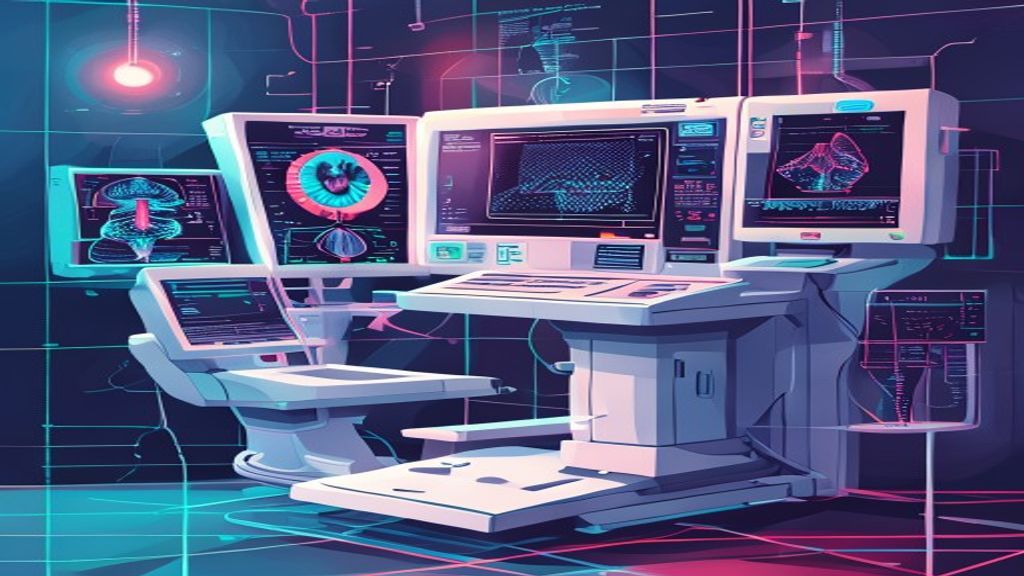
The company that turned "a fantasy dragon in the style of Studio Ghibli" into a cultural phenomenon now wants to scan the inside of your body. Midjourney, best known for its AI image generator, just unveiled its first physical hardware product: a full-body ultrasound scanner that its CEO believes could rival MRI machines. That is a very large swing from cat pictures.
Here is how it works. You step onto a platform, descend into a warm pool of water, and pass through a ring of thousands of ultrasonic sensors. Those sensors fire sound waves through your body from every direction, record how those waves bounce and ripple, and then reconstruct a detailed 3D picture of what is going on inside you. The whole process takes about 60 seconds. Think of it as a thousand tiny dolphins echolocating your liver simultaneously.
The device, called The Midjourney Scanner, was built in partnership with Butterfly Network, a medical ultrasound company whose chip technology powers the 40 imaging modules in each unit. Two petaflops of onboard processing crunch the raw wave data into usable images. CEO David Holz says the goal is image quality comparable to MRI, which is an extraordinary claim for a technology that is still in its early days and has scanned roughly a dozen people so far.
The vision Holz is selling is less clinical and more... wellness retreat. He wants to open a Midjourney Spa in San Francisco's Union Square before the end of 2027, housing ten of these scanners alongside a gym, saunas, and cold plunges. The pitch is that you could stop in annually, or even daily, to track how your body composition shifts in response to diet changes, new workout routines, or just the slow grind of aging. Holz himself mentioned wanting to measure his own body more regularly, framing this less as a medical device and more as a quantified-self tool for people who really want to know what is happening underneath the surface.
There is a genuinely interesting idea buried here. Preventative health screening is expensive, slow, and often requires a doctor's referral. If Midjourney can deliver fast, affordable, high-quality body scans in a comfortable environment, that is a real gap worth filling. The problem is that "interesting idea" and "functional medical product" are separated by a very wide regulatory moat. Holz acknowledged that medical applications will need FDA clearance, and the company has not said much about how it plans to navigate that process.
There is also a lingering question about what Midjourney's core image generation technology actually contributes here. The connection between generating AI art and processing ultrasound wave data is not obvious, and Holz has not made a fully convincing case that this is synergy rather than a CEO with spare compute capacity and a side passion project.
Still, it is hard to call this boring. The AI industry is full of companies chasing the same benchmarks. Midjourney just walked into a room and said it wants to build a medical spa. Points for originality.

AI
Tiny 3B model claims to beat OpenAI and Google at reasoning tasks
A model with three billion parameters is reportedly outperforming systems built by OpenAI and Google on reasoning benchmarks, and the AI community is doing what it does best: arguing loudly about whether any of it means anything.
The model in question is VibeThinker 3B, developed by Weibo, the Chinese social media platform that most Western audiences know as a Twitter-adjacent app rather than an AI research lab. That context matters. VibeThinker is not coming from a company with tens of thousands of GPUs and a decade of foundation model research. It is a relatively small team claiming a very large result, which is either a genuine breakthrough in efficient AI or a masterclass in benchmark gaming, depending on who you ask.
Three billion parameters is genuinely tiny by modern standards. For comparison, the models powering the premium tiers of ChatGPT and Gemini are estimated to be orders of magnitude larger. The entire premise of the "bigger is better" era of AI was that raw scale drove raw capability. What VibeThinker appears to be testing is whether the right training approach, particularly focused on reasoning and chain-of-thought techniques, can close that gap in ways that raw size cannot.
The specific benchmarks where VibeThinker allegedly shines are math and logical reasoning tasks, the kind where a model needs to work through a problem step by step rather than pattern-match to a memorized answer. This is a domain where larger models have traditionally dominated because they can hold more context and make more nuanced inferences. If a 3B model is genuinely competitive here, that is a meaningful signal about the direction the field is heading.
But the benchmark debate is where things get messy. Critics are pointing out that performance on curated reasoning tests does not always translate to real-world usefulness. There is also the perennial concern about data contamination, the possibility that benchmark questions or very similar problems appeared in the model's training data, inflating scores without reflecting genuine reasoning ability. These are not new accusations in AI research, but they are particularly pointed when a small team makes headline-grabbing claims against well-resourced incumbents.
What makes this worth paying attention to, skepticism and all, is the broader trend it represents. Efficient small models have been quietly chipping away at the dominance of expensive giants for over a year now. Meta's Llama series, Microsoft's Phi models, and Google's Gemma line have all demonstrated that careful training on high-quality data can punch well above a model's weight class. VibeThinker fits into that lineage, even if its specific claims deserve scrutiny.
The practical implication is real regardless of whether VibeThinker's benchmarks hold up under pressure. Smaller models are cheaper to run, easier to deploy on-device, and accessible to developers who cannot afford enterprise API pricing. Every time a small model credibly challenges a large one, it puts pressure on the entire industry to justify why anyone should be paying for the big version in the first place.
Source: VentureBeat
The model in question is VibeThinker 3B, developed by Weibo, the Chinese social media platform that most Western audiences know as a Twitter-adjacent app rather than an AI research lab. That context matters. VibeThinker is not coming from a company with tens of thousands of GPUs and a decade of foundation model research. It is a relatively small team claiming a very large result, which is either a genuine breakthrough in efficient AI or a masterclass in benchmark gaming, depending on who you ask.
Three billion parameters is genuinely tiny by modern standards. For comparison, the models powering the premium tiers of ChatGPT and Gemini are estimated to be orders of magnitude larger. The entire premise of the "bigger is better" era of AI was that raw scale drove raw capability. What VibeThinker appears to be testing is whether the right training approach, particularly focused on reasoning and chain-of-thought techniques, can close that gap in ways that raw size cannot.
The specific benchmarks where VibeThinker allegedly shines are math and logical reasoning tasks, the kind where a model needs to work through a problem step by step rather than pattern-match to a memorized answer. This is a domain where larger models have traditionally dominated because they can hold more context and make more nuanced inferences. If a 3B model is genuinely competitive here, that is a meaningful signal about the direction the field is heading.
But the benchmark debate is where things get messy. Critics are pointing out that performance on curated reasoning tests does not always translate to real-world usefulness. There is also the perennial concern about data contamination, the possibility that benchmark questions or very similar problems appeared in the model's training data, inflating scores without reflecting genuine reasoning ability. These are not new accusations in AI research, but they are particularly pointed when a small team makes headline-grabbing claims against well-resourced incumbents.
What makes this worth paying attention to, skepticism and all, is the broader trend it represents. Efficient small models have been quietly chipping away at the dominance of expensive giants for over a year now. Meta's Llama series, Microsoft's Phi models, and Google's Gemma line have all demonstrated that careful training on high-quality data can punch well above a model's weight class. VibeThinker fits into that lineage, even if its specific claims deserve scrutiny.
The practical implication is real regardless of whether VibeThinker's benchmarks hold up under pressure. Smaller models are cheaper to run, easier to deploy on-device, and accessible to developers who cannot afford enterprise API pricing. Every time a small model credibly challenges a large one, it puts pressure on the entire industry to justify why anyone should be paying for the big version in the first place.
Enjoyed this?
Get stories like this delivered every Tuesday — free.