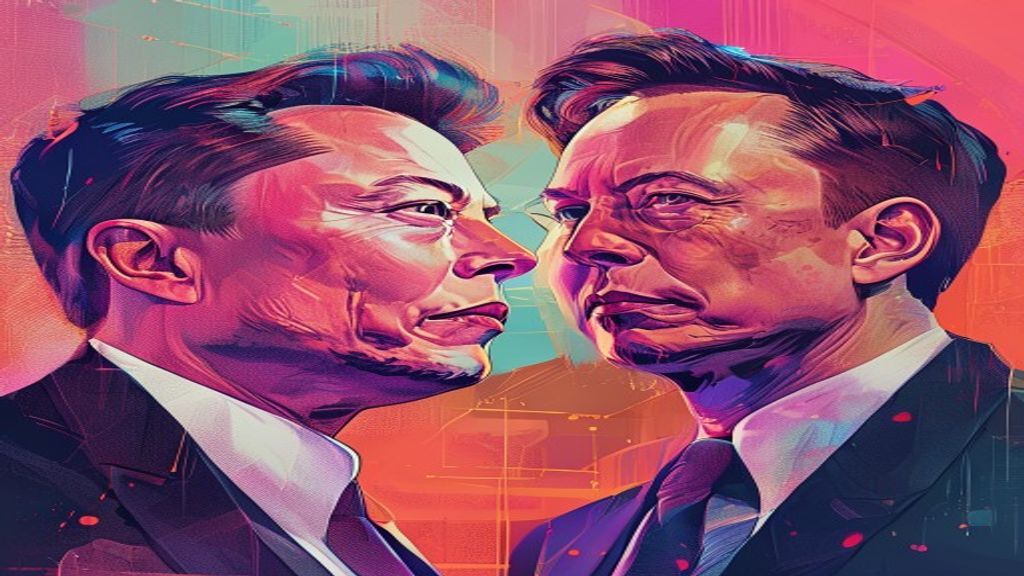
A law professor who reviewed the case essentially said Musk's legal team is only here because Musk can afford to lose. That single detail tells you almost everything you need to know about what's happening in Oakland, California, where the Musk v. Altman trial kicked off on April 27th.
On paper, this is a lawsuit alleging that OpenAI defrauded Elon Musk — the company's original co-founder who departed before it became the most talked-about startup on the planet. In practice, it's the most expensive, legally formalized beef in tech history. Musk has cycled through legal theories like they're Netflix shows: breach of contract, unfair business practices, false advertising. None of them have stuck particularly well. And yet, here we are, at trial.
The timing is not accidental. Musk's AI company xAI — now folded into SpaceX — is pursuing an IPO. OpenAI is reportedly eyeing one too. Both sides have enormous financial incentives to look dominant and trustworthy right now. A public trial drags both into a very uncomfortable spotlight at a very inconvenient moment.
What makes this genuinely compelling isn't the legal arguments. It's the paper trail. Internal documents, diary excerpts, and deposition transcripts have been surfacing in the docket for weeks, and they read less like corporate filings and more like a group chat that got leaked. OpenAI President Greg Brockman's diary entries have made the rounds. Mark Zuckerberg — who has nothing to do with this lawsuit — somehow ended up with embarrassing texts in the public record, including one where he allegedly told Musk that Meta teams were ready to remove content targeting DOGE personnel, despite Zuckerberg's public stance against government-influenced moderation. Musk, for his part, is on record calling Jeff Bezos "a bit of a tool."
None of this is central to the legal questions at hand. All of it is central to why anyone is actually paying attention.
Over the coming weeks, the witness list reads like a who's-who of the AI industry's formative years. Microsoft CEO Satya Nadella and CTO Kevin Scott are expected to testify. Former OpenAI figures including Ilya Sutskever and Mira Murati may take the stand. So might the board members responsible for Sam Altman's short-lived and chaotic firing in 2023 — a saga that still doesn't have a fully satisfying public explanation.
Altman himself will testify. So will Musk.
Law professor Sam Brunson from Loyola University Chicago put it plainly: if this were a contingency case, no attorney would expect to get paid. That's a polite way of saying the legal merits are thin. But legal merit was never really the point. Musk has used litigation as a reputational weapon before — against nonprofits, against the firm that forced him to complete the Twitter acquisition, across his sprawling business empire.
This trial is less a courtroom drama and more a very expensive, legally-sanctioned way to make OpenAI's leadership look bad at the worst possible time. Whether it works is a different question entirely.

AI
DeepSeek V4 Preview Challenges Top US AI Models in Coding
DeepSeek didn't just release a new model this week — it explicitly called out Google, Anthropic, and OpenAI by name and said its latest system can go toe-to-toe with all of them. That's either very confident or very well-earned, and the early signs suggest it might be the latter.
The Chinese AI lab dropped a preview of its next-generation V4 model on Friday, positioning it as a major leap over its predecessors with a particular emphasis on coding performance. Coding has quietly become the most contested battleground in AI right now. Tools like Claude Code and ChatGPT's Codex have turned code generation into a flagship capability — the thing enterprises actually pay for at scale. If DeepSeek can genuinely compete there, that matters well beyond benchmark bragging rights.
V4 is open-source, which is itself a statement. The leading American labs have largely kept their most powerful models behind closed APIs and paywalls. DeepSeek releasing a competitive model openly is a strategic move as much as a technical one — it accelerates adoption, invites scrutiny, and makes the case that closed models don't have an inherent quality advantage.
One detail buried in the release deserves more attention than it's getting: DeepSeek specifically highlighted V4's compatibility with Huawei's domestic chip hardware. That's not a footnote. The US has spent years tightening export controls on advanced semiconductors, specifically to limit China's ability to train frontier AI models. If DeepSeek is signaling that it can build competitive systems on non-Nvidia hardware, that's a direct challenge to one of Washington's core assumptions about how to maintain an AI edge.
The company hasn't disclosed what hardware V4 was actually trained on, or what it cost. That opacity isn't surprising — DeepSeek has been careful about these details since R1 launched roughly a year ago and sent American AI stocks into a brief but memorable panic. US officials have alleged DeepSeek used banned Nvidia chips to train its models. Anthropic has separately claimed DeepSeek used Claude's outputs to improve its own systems, a practice known as model distillation that sits in a legal and ethical gray zone.
None of those allegations have been proven, and DeepSeek hasn't publicly addressed them in detail. What the company has done is keep shipping.
The V4 release lands at a moment when the American AI industry is deeply invested in the narrative that frontier model development requires massive capital, cutting-edge chips, and years of proprietary research. DeepSeek keeps complicating that story. Whether V4 truly matches GPT-4-level performance across real-world tasks — not just curated benchmarks — will become clearer as developers get hands-on time with it.
But the pattern is hard to ignore. Every few months, DeepSeek releases something that forces a recalibration of what's possible and who's actually leading this race.
Source: The Verge
The Chinese AI lab dropped a preview of its next-generation V4 model on Friday, positioning it as a major leap over its predecessors with a particular emphasis on coding performance. Coding has quietly become the most contested battleground in AI right now. Tools like Claude Code and ChatGPT's Codex have turned code generation into a flagship capability — the thing enterprises actually pay for at scale. If DeepSeek can genuinely compete there, that matters well beyond benchmark bragging rights.
V4 is open-source, which is itself a statement. The leading American labs have largely kept their most powerful models behind closed APIs and paywalls. DeepSeek releasing a competitive model openly is a strategic move as much as a technical one — it accelerates adoption, invites scrutiny, and makes the case that closed models don't have an inherent quality advantage.
One detail buried in the release deserves more attention than it's getting: DeepSeek specifically highlighted V4's compatibility with Huawei's domestic chip hardware. That's not a footnote. The US has spent years tightening export controls on advanced semiconductors, specifically to limit China's ability to train frontier AI models. If DeepSeek is signaling that it can build competitive systems on non-Nvidia hardware, that's a direct challenge to one of Washington's core assumptions about how to maintain an AI edge.
The company hasn't disclosed what hardware V4 was actually trained on, or what it cost. That opacity isn't surprising — DeepSeek has been careful about these details since R1 launched roughly a year ago and sent American AI stocks into a brief but memorable panic. US officials have alleged DeepSeek used banned Nvidia chips to train its models. Anthropic has separately claimed DeepSeek used Claude's outputs to improve its own systems, a practice known as model distillation that sits in a legal and ethical gray zone.
None of those allegations have been proven, and DeepSeek hasn't publicly addressed them in detail. What the company has done is keep shipping.
The V4 release lands at a moment when the American AI industry is deeply invested in the narrative that frontier model development requires massive capital, cutting-edge chips, and years of proprietary research. DeepSeek keeps complicating that story. Whether V4 truly matches GPT-4-level performance across real-world tasks — not just curated benchmarks — will become clearer as developers get hands-on time with it.
But the pattern is hard to ignore. Every few months, DeepSeek releases something that forces a recalibration of what's possible and who's actually leading this race.
Enjoyed this?
Get stories like this delivered every Tuesday — free.