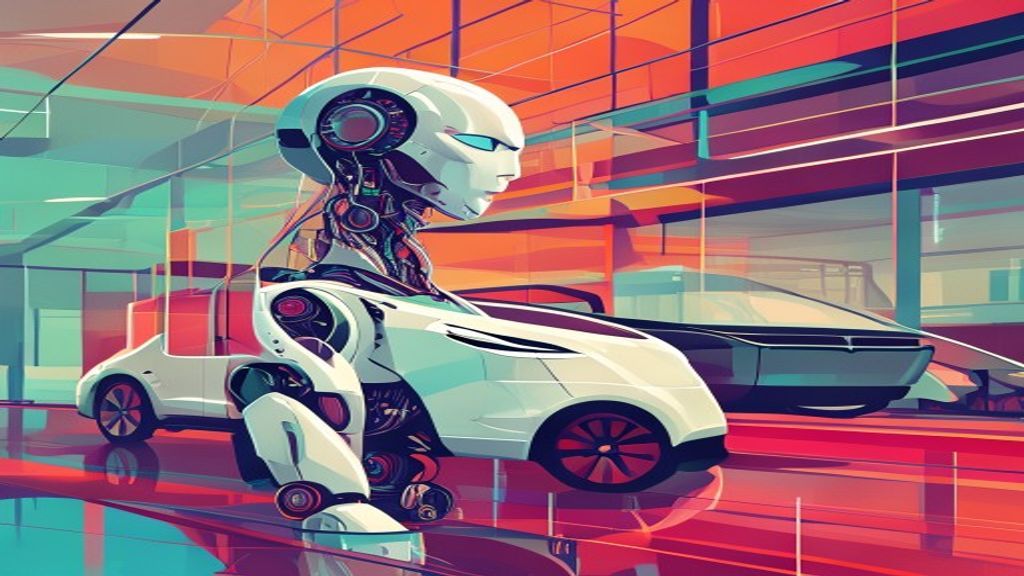
Tesla's Shanghai Gigafactory has already pulled off one reinvention — going from a greenfield construction site in 2019 to one of the most productive EV plants on the planet. Now the company is quietly eyeing a second act: building humanoid robots there.
Wang Hao, Tesla China's president, recently hinted at the ambition, saying the Shanghai facility would play a central role in robot production as the robotics era takes shape. He stopped well short of giving specifics — no timelines, no production targets, no cost figures. But the direction of travel is clear enough.
This matters for a few reasons. First, the Shanghai factory is not just a manufacturing site — it's Tesla's most strategically important plant outside the US, accounting for a massive share of global vehicle output and serving as the primary hub for Asian markets. Layering humanoid robot production on top of that existing infrastructure would be a significant bet on China as a robotics manufacturing base, not just a consumer market.
Second, Tesla is playing catch-up in a race that's moving fast. China already has a dense cluster of homegrown humanoid robot startups — companies like Unitree and AgiBot are iterating quickly and manufacturing domestically. If Tesla wants to compete on cost and speed in the Chinese market, building Optimus robots locally rather than importing them from the US makes obvious sense.
There's also a political dimension worth acknowledging. US-China trade tensions have made cross-border manufacturing more complicated and more expensive. Producing robots in Shanghai sidesteps some of that friction, at least for units destined for the Chinese market. It's the same logic that originally made the Shanghai Gigafactory such a smart move for EVs.
The factory's evolution tells its own story. It started with electric cars, added large-scale energy storage batteries in 2025, and now robots are potentially next. Each addition has expanded Tesla's footprint in China and deepened its ties to local supply chains, local talent, and local regulators.
What remains genuinely unclear is how serious this is right now versus how serious Tesla wants investors to believe it is. The company has a well-documented habit of announcing ambitious manufacturing plans and then letting the timeline quietly stretch. Optimus has been promised at scale before, and the goalposts have moved more than once.
Still, the Shanghai angle gives this particular iteration more credibility than previous announcements. The infrastructure exists, the workforce is trained, and the supply chain relationships are already in place. The question isn't really whether Tesla can build humanoid robots in Shanghai — it's whether they can do it fast enough to matter in a market that isn't waiting around.

AI
China AI Token Usage Surpasses 140 Trillion Daily, Up 40 Percent
One hundred and forty trillion tokens. Per day. That's the number China's National Bureau of Statistics put on the country's AI usage in March, and it's up more than 40 percent from where things stood just a few months earlier at the end of 2025. Let that sink in for a second.
Tokens are the basic unit of how large language models process and generate text — roughly speaking, a token is about three-quarters of a word. So 140 trillion daily tokens represents an almost incomprehensible volume of AI-assisted activity, whether that's customer service bots, coding assistants, content generation, or enterprise software running inference in the background.
Mao Shengyong, deputy head of the NBS, shared the figure at a State Council briefing, framing it as evidence that China has reached meaningful scale in deploying AI across industries rather than just experimenting with it in labs. That framing is important. There's a difference between a country that's building AI models and a country that's actually using them at volume in commercial settings. China appears to be doing both simultaneously.
The ripple effects are showing up in the manufacturing data, and the numbers are striking. Integrated circuit manufacturing grew 49.4 percent year-over-year in the first quarter. Electronic special materials — the inputs that go into chips and hardware — rose 32.5 percent. These aren't rounding errors. They're signs of a supply chain scaling hard to keep up with surging demand.
For context, this kind of industrial response is exactly what you'd expect when AI adoption crosses from early-mover territory into mainstream deployment. Companies start running inference at scale, data centers need more chips, chip makers need more materials, and suddenly the growth shows up three or four levels deep in the supply chain.
The broader digital manufacturing sector grew 11.2 percent in Q1, which sounds more modest but represents enormous absolute output given the size of China's industrial base. It's the kind of steady underlying growth that tends to compound quietly until it's impossible to ignore.
What this data doesn't tell you is how that token usage breaks down — which industries are driving it, which models are being used, and how much of it is genuinely productive versus being burned on low-value automation. Token counts are a measure of activity, not necessarily of value created.
But even with that caveat, the trajectory is hard to dismiss. A 40 percent jump in AI usage in roughly three months suggests that deployment is accelerating, not plateauing. And when a country's statistics bureau starts tracking token usage the way it tracks industrial output, you know AI has moved from a tech story into an economic one.
Source: TechNode
Tokens are the basic unit of how large language models process and generate text — roughly speaking, a token is about three-quarters of a word. So 140 trillion daily tokens represents an almost incomprehensible volume of AI-assisted activity, whether that's customer service bots, coding assistants, content generation, or enterprise software running inference in the background.
Mao Shengyong, deputy head of the NBS, shared the figure at a State Council briefing, framing it as evidence that China has reached meaningful scale in deploying AI across industries rather than just experimenting with it in labs. That framing is important. There's a difference between a country that's building AI models and a country that's actually using them at volume in commercial settings. China appears to be doing both simultaneously.
The ripple effects are showing up in the manufacturing data, and the numbers are striking. Integrated circuit manufacturing grew 49.4 percent year-over-year in the first quarter. Electronic special materials — the inputs that go into chips and hardware — rose 32.5 percent. These aren't rounding errors. They're signs of a supply chain scaling hard to keep up with surging demand.
For context, this kind of industrial response is exactly what you'd expect when AI adoption crosses from early-mover territory into mainstream deployment. Companies start running inference at scale, data centers need more chips, chip makers need more materials, and suddenly the growth shows up three or four levels deep in the supply chain.
The broader digital manufacturing sector grew 11.2 percent in Q1, which sounds more modest but represents enormous absolute output given the size of China's industrial base. It's the kind of steady underlying growth that tends to compound quietly until it's impossible to ignore.
What this data doesn't tell you is how that token usage breaks down — which industries are driving it, which models are being used, and how much of it is genuinely productive versus being burned on low-value automation. Token counts are a measure of activity, not necessarily of value created.
But even with that caveat, the trajectory is hard to dismiss. A 40 percent jump in AI usage in roughly three months suggests that deployment is accelerating, not plateauing. And when a country's statistics bureau starts tracking token usage the way it tracks industrial output, you know AI has moved from a tech story into an economic one.
Enjoyed this?
Get stories like this delivered every Tuesday — free.