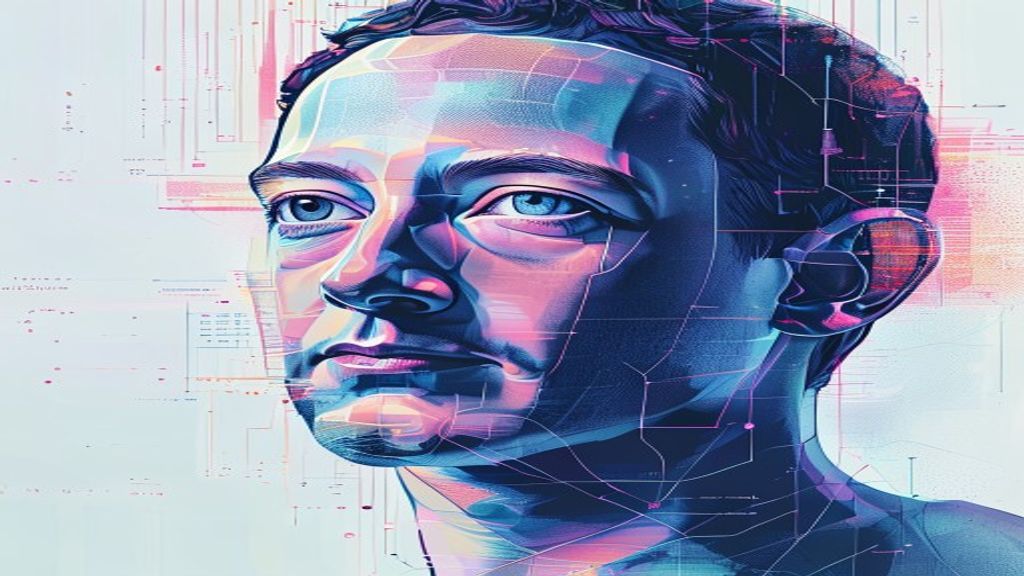
The most powerful person at Meta may soon be someone who technically doesn't exist. Mark Zuckerberg is apparently building an AI version of himself — trained on his voice, his face, his communication style, and years of public statements — so that employees can interact with a digital stand-in when the real one isn't available.
Let that sink in for a second. We've gone from "the CEO sends a memo" to "the CEO sends himself."
According to reporting from the Financial Times, the project is designed to make employees feel more connected to Zuckerberg by giving them access to something that looks, sounds, and responds like him. Whether that actually achieves the goal or just makes Monday morning standups significantly more unsettling remains to be seen.
This isn't some fringe experiment happening in a skunkworks lab. Zuckerberg is personally involved in training the avatar, and he's reportedly been logging five to ten hours a week on Meta's AI projects more broadly — attending technical reviews and writing actual code. For a CEO running a company with billions of users across multiple platforms, that's a meaningful time commitment to one initiative.
The clone is also separate from a personal AI agent Zuckerberg is reportedly building to help him manage tasks — a project the Wall Street Journal surfaced earlier this year. So to be clear: there's the real Zuckerberg, an AI assistant helping him work, and now a third entity built to represent him to other humans. The org chart implications alone are dizzying.
Meta's broader ambitions here are worth watching closely. The company has signaled it may open up similar tools to creators if the internal experiment goes well — letting influencers and public figures deploy AI versions of themselves to respond to followers on Instagram and Facebook. Meta already showed off a prototype of this in 2024, and it quietly rolled out AI-assisted comment replies for creators not long after.
This is where it gets genuinely interesting from a business standpoint. If Meta can normalize the idea of interacting with an AI that convincingly mimics a real person — starting with the CEO as the test subject — it builds the foundation for a creator economy where human attention is no longer the bottleneck. Your favorite creator can be everywhere at once, theoretically.
The obvious counterpoint is that people generally like knowing they're talking to a real person, and the line between "helpful AI persona" and "deceptive impersonation" is going to get blurry fast. Meta has already started restricting AI chatbot access for teenagers, which suggests the company is at least somewhat aware that not every use case is benign.
But for now, Zuckerberg is betting that the future of leadership communication runs through a model trained on his own data. If it works internally, the rest of us probably aren't far behind.

POLICY
France Is Ditching Windows and Moving 2.5 Million Desktops to Linux
France just did something that IT administrators and open-source advocates have been predicting — and quietly doubting — for roughly two decades. On April 8, 2026, the French government formally ordered every ministry to draft a migration plan away from Windows and onto Linux, with plans submitted by fall of this year. All 2.5 million civil servant workstations are in scope.
This is not a pilot program. It is not a strongly worded policy document that gets ignored at implementation. Every ministry has been told to map its dependencies on non-European software and show its work.
The political framing coming from Paris is striking in its directness. France's minister of public action essentially declared that acknowledging technological dependence on American companies is no longer sufficient — the state has to actively break that dependence. "Digital sovereignty is not optional" was the actual quote from a senior government official. That's the kind of language you'd expect from a tech policy manifesto, not a bureaucratic announcement.
The timing matters a lot here. Concern about relying on US software companies has been building across the European Union for years, sharpened by debates over data privacy, the reach of American cloud infrastructure, and a growing sense that European governments are structurally exposed to decisions made in Seattle and Menlo Park. France is the first to translate that anxiety into a concrete, large-scale desktop migration order.
This also isn't France starting from zero. Earlier in 2026, the country already mandated that its civil servants abandon Microsoft Teams and Zoom in favor of Visio, a French-built communications platform, by 2027. The desktop move is the next layer of the same strategy — building a software stack that doesn't depend on companies outside French or European jurisdiction.
For Linux, the implications are significant. Desktop Linux has long been the perpetual underdog — capable, free, and chronically under-adopted outside of developer circles. A government commitment at this scale doesn't just affect France's own infrastructure. It signals to other EU member states that the migration is survivable, and it creates pressure on vendors, developers, and IT procurement teams across the continent to take Linux seriously as an enterprise desktop platform.
The counterargument, predictably, is that 2.5 million desktops is an enormous undertaking, and government IT migrations have a rich history of going over budget, over schedule, and under-delivered. Legacy software dependencies, specialized tools built on Windows APIs, and simple user resistance are all real obstacles.
But France has apparently been doing the groundwork — building out sovereign backend services and pushing alternative software tools before announcing the headline desktop switch. Whether execution matches ambition is the real test. If it does, expect this story to look a lot bigger in hindsight than it does today.
Source: ZDNet
This is not a pilot program. It is not a strongly worded policy document that gets ignored at implementation. Every ministry has been told to map its dependencies on non-European software and show its work.
The political framing coming from Paris is striking in its directness. France's minister of public action essentially declared that acknowledging technological dependence on American companies is no longer sufficient — the state has to actively break that dependence. "Digital sovereignty is not optional" was the actual quote from a senior government official. That's the kind of language you'd expect from a tech policy manifesto, not a bureaucratic announcement.
The timing matters a lot here. Concern about relying on US software companies has been building across the European Union for years, sharpened by debates over data privacy, the reach of American cloud infrastructure, and a growing sense that European governments are structurally exposed to decisions made in Seattle and Menlo Park. France is the first to translate that anxiety into a concrete, large-scale desktop migration order.
This also isn't France starting from zero. Earlier in 2026, the country already mandated that its civil servants abandon Microsoft Teams and Zoom in favor of Visio, a French-built communications platform, by 2027. The desktop move is the next layer of the same strategy — building a software stack that doesn't depend on companies outside French or European jurisdiction.
For Linux, the implications are significant. Desktop Linux has long been the perpetual underdog — capable, free, and chronically under-adopted outside of developer circles. A government commitment at this scale doesn't just affect France's own infrastructure. It signals to other EU member states that the migration is survivable, and it creates pressure on vendors, developers, and IT procurement teams across the continent to take Linux seriously as an enterprise desktop platform.
The counterargument, predictably, is that 2.5 million desktops is an enormous undertaking, and government IT migrations have a rich history of going over budget, over schedule, and under-delivered. Legacy software dependencies, specialized tools built on Windows APIs, and simple user resistance are all real obstacles.
But France has apparently been doing the groundwork — building out sovereign backend services and pushing alternative software tools before announcing the headline desktop switch. Whether execution matches ambition is the real test. If it does, expect this story to look a lot bigger in hindsight than it does today.
Enjoyed this?
Get stories like this delivered every Tuesday — free.